


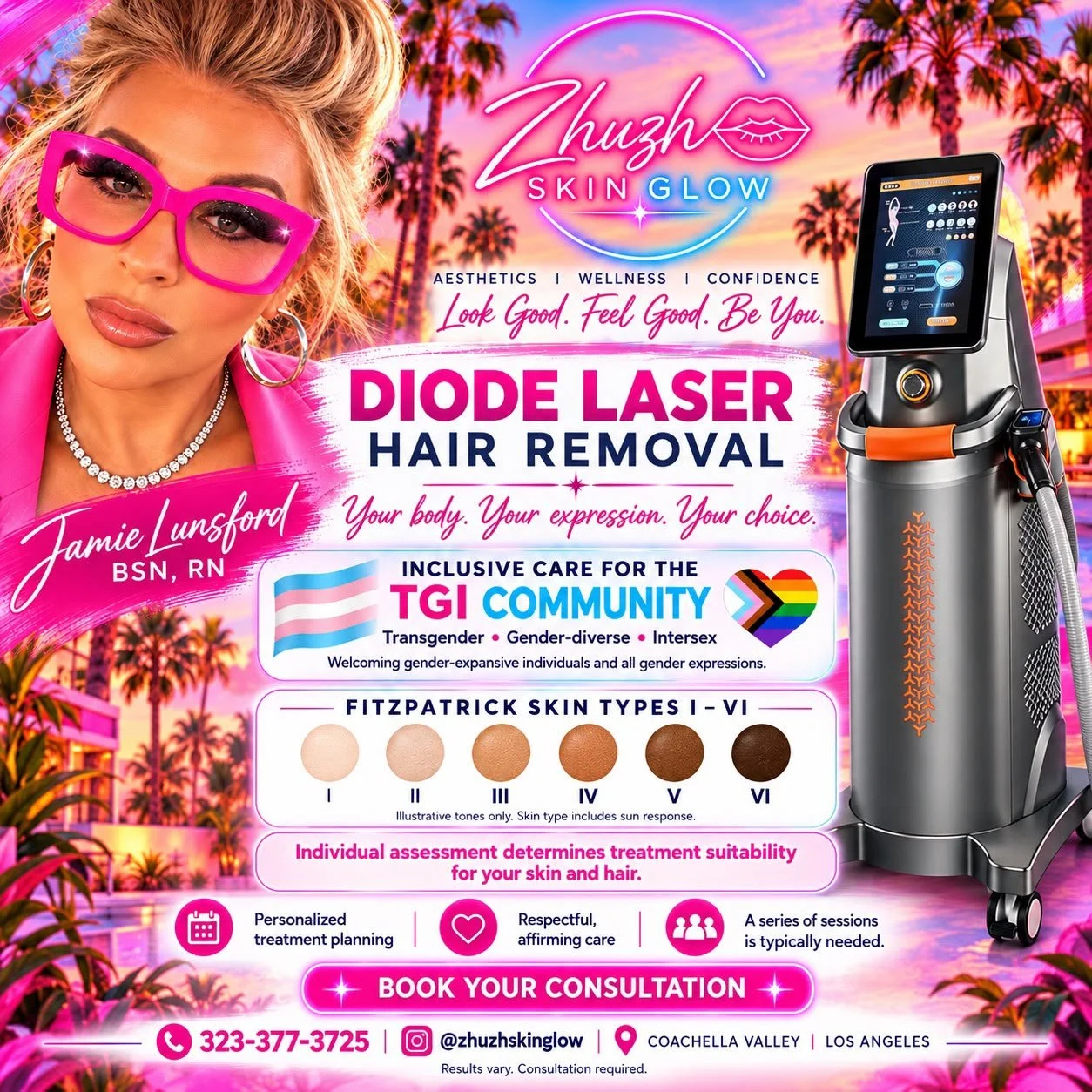
Laser hair removal can work across all six Fitzpatrick skin types. The laser targets melanin, the pigment that gives hair and skin their color. Dark hair absorbs the laser light and converts it to heat. That heat damages the follicle’s ability to grow another hair. The surrounding skin also absorbs some light, so the choice of laser matters more as the amount of pigment in the skin increases.
Laser Hair Removal
How laser choice changes by skin type
The Fitzpatrick scale describes how your skin usually burns and tans in the sun. It's a starting point. A clinician also needs to assess the current color of the area being treated, any recent tan, and the color and thickness of the hair.
Type I
Sun response: Burns readily and doesn't tan.
What it means: Dark hair stands out strongly against lightly pigmented skin. A 755 nm alexandrite or an 800-810 nm diode can work well when the hair is dark.
Type II
Sun response: Burns easily and tans slightly.
What it means: Alexandrite and diode are common choices. Someone with fair skin and coarse brown hair will generally respond better than someone with equally fair skin and blond hair.
Type III
Sun response: May burn at first, then tans.
What it means: Alexandrite or diode can work well on untanned skin. A recent tan adds pigment at the surface, so even a person who did well at an earlier visit may need to wait before the next session.
Type IV
Sun response: Burns minimally and tans easily.
What it means: A diode can be an option with appropriate settings and cooling. A long-pulsed 1064 nm Nd:YAG is often preferred because less of its energy is absorbed by pigment near the skin's surface.
Type V
Sun response: Rarely burns and tans deeply.
What it means: Long-pulsed Nd:YAG is generally preferred. It can heat coarse, dark hair while reducing the chance of overheating the surrounding skin and leaving dark or light marks.
Type VI
Sun response: Deeply pigmented skin that very rarely burns.
What it means: Long-pulsed Nd:YAG is also generally preferred. Skin cooling and a clinician experienced in treating deeply pigmented skin remain important, even with this wavelength.
Where diode fits in: A typical 810 nm diode falls between 755 nm alexandrite and 1064 nm Nd:YAG. At 810 nm, skin pigment absorbs more of the light than it does at 1064 nm. That's why an 810 nm diode can work well for many patients, while long-pulsed Nd:YAG generally gives a wider safety margin for deeply pigmented skin. The Glendale clinic you asked about lists a Candela GentleMax Pro, which offers alexandrite and Nd:YAG wavelengths.Hair color matters at every skin tone. Coarse black or dark brown hair usually responds best. For example, someone with type V skin and a mix of black and gray chin hairs may see the black hairs become finer and fewer while the gray hairs remain. White and gray hairs lack enough pigment for the laser to target, and blond or red hairs usually respond poorly.
Several sessions are needed because the follicle is most vulnerable during active growth, and neighboring hairs enter that phase at different times. The expected result is long-term hair reduction. Some hair can regrow, often finer, and maintenance treatments may be needed.
For fingers alone, beard-line shaping, or an extended bikini, call (818) 248-9575 to confirm coverage and pricing. Fix’s menu lists hands, beard, bikini line, and full bikini as its corresponding options. Official price list

Ready to glow?
Book your appointment at the nearest
Zhuzh Skin Glow!
Frequently Asked Questions
-
Yes, it can work on all six Fitzpatrick skin types, but the laser has to match your skin. Lighter skin usually does well with alexandrite or diode lasers, while darker skin (types V and VI) is generally treated with Nd:YAG, which is safer for skin with more pigment.
-
Yes. Coarse black or dark brown hair responds best. White, gray, blond, and red hair have little pigment, so the laser usually can't target them well.
-
Hair is only vulnerable during its active growth phase, and your hairs don't all grow on the same schedule. Multiple visits catch more of them.
-
The duration of results from a PDO Thread Lift depends on the treated area and the number of threads used. Treatments around the mouth, fine lines, and lip enhancement can last 3-6 months, while lifting treatments for the brow, neck, and lower face can last up to 2 years.
-
It gives long-term hair reduction, not guaranteed permanent removal. Some hair may grow back, usually finer, and you may need occasional touch-ups.
Say goodbye to unwanted hair with Laser Hair Removal and enjoy smoother, longer-lasting results. Contact our Medspa today to schedule your consultation and take the first step towards silky, hair-free skin.
Contact us today or visit us at 1833 West Vernon Avenue,
Los Angeles, CA 90062 to schedule your consultation and take the first step towards revitalized skin.
BOOK NOW →